Guides
Design a base edit
Single-base changes without a double-strand break. The hard parts are the activity window and the bystanders, and both are where a clean-looking design produces a confusing result.
Updated 31 July 2026
All documentation
On this page
A base editor is a catalytically impaired Cas fused to a deaminase. It does not cut — it chemically converts one base to another. That avoids the double-strand break entirely, and it trades one problem for a different one: you can only edit bases the deaminase can physically reach, and it will edit all of them.
Switch to base-edit mode
In the CRISPR designer, set Mode to Base edit. This is SpCas9 only — Cas12a has no base-editor geometry here.
Where the knockout pipeline asks where will Cas9 cut, and how cleanly?, this asks which single-base change does this guide install, and what does that do to the protein?
Pick an editor
| Editor | Family | Change | Window |
|---|---|---|---|
be4max (default) |
CBE | C→T | 4–8 |
be3 |
CBE | C→T | 4–8 |
evocda_be4max |
CBE | C→T | 2–10 |
abe8e |
ABE | A→G | 3–9 |
abe7.10 |
ABE | A→G | 4–7 |
Choose on family first — CBE for C→T, ABE for A→G — then on window width. A wide window like evoCDA1’s 2–10 reaches bases the others cannot, at the cost of more bystanders. A narrow one like ABE7.10’s 4–7 is the opposite trade.
Positions are 1-indexed from the 5′, PAM-distal end of the spacer. For SpCas9
the protospacer is positions 1–20 and the NGG PAM sits at 21–23.
The windows are literature consensus, not a trained model
They rank-order candidates sensibly. They are not calibrated efficiency predictions for your editor variant, cell type or delivery method. A base inside the window is reachable, not guaranteed to be edited.
Check the bystanders
This is the part that catches people out. The deaminase does not know which base you meant. Every base of the same type inside the window is a candidate.
If you want to edit the C at position 5 with BE4max, and there is another C at position 7, both are in the 4–8 window and both are likely to convert. The engine reports the predicted edit and every bystander alongside it, which is the difference between a design that looks clean and a result you can interpret.
Most competing tools only flag that a guide is base-editable. What matters is which specific bases change.
A bystander is not automatically a problem
A bystander in a wobble position may be silent. The amino-acid consequence column is what tells you — read that, not the bystander count alone.
Read the amino-acid consequence
When the reading frame is known, each predicted edit is translated: the codon before, the codon after, and the resulting amino acid change.
Three outcomes worth recognising:
- Silent — the codon changed, the amino acid did not. Often true of bystanders, and the reason a bystander count alone is misleading.
- Missense — the substitution you were probably aiming for.
- Nonsense — a premature stop. Deliberately inducing one is CRISPR-STOP / iSTOP: a knockout with no double-strand break, no indel spectrum and no repair lottery. Where a nonsense edit is reachable, it is often a cleaner knockout than cutting.
Read the four base-edit columns
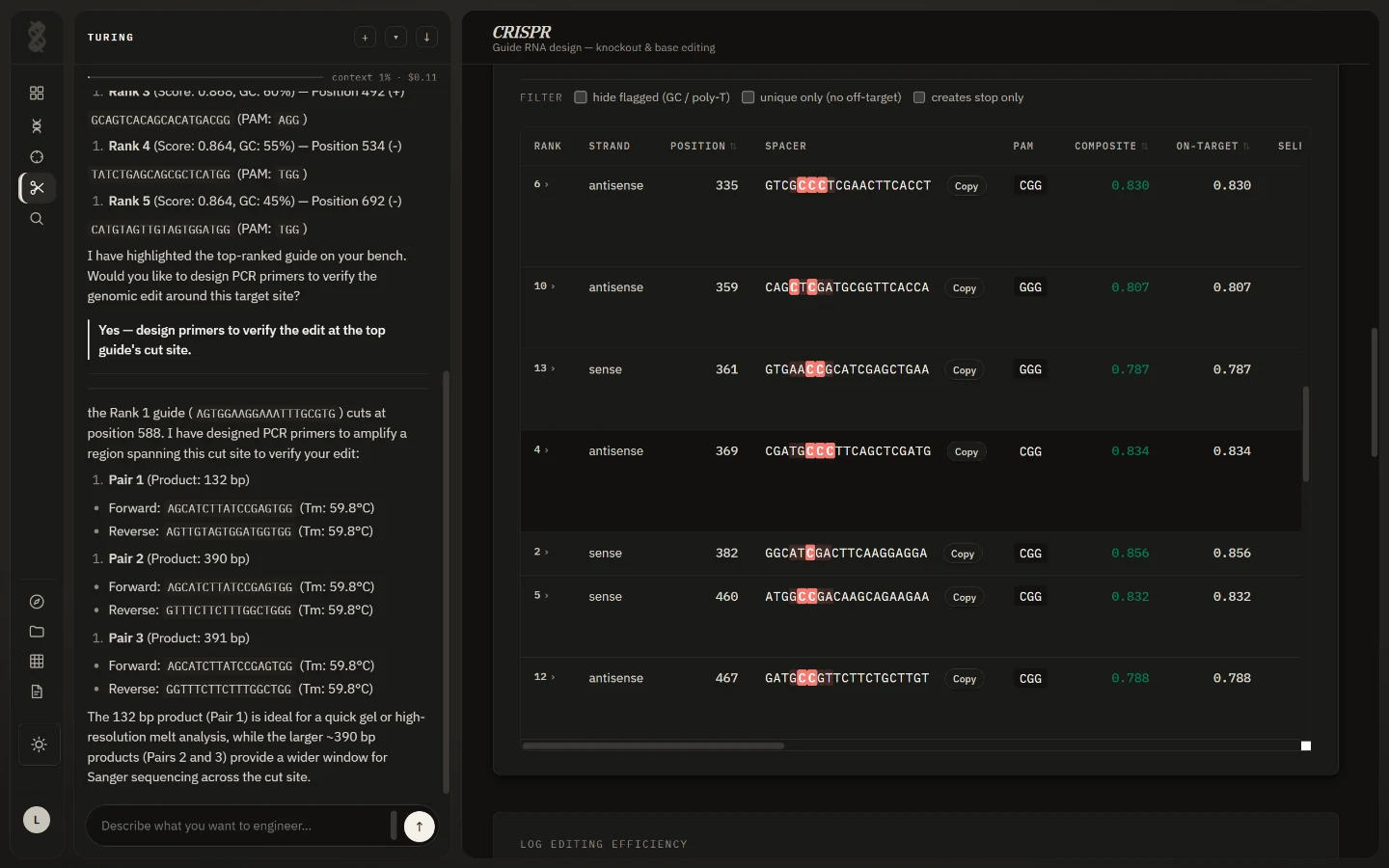
Base-edit mode adds four columns to the twenty in the knockout table — Edit,
Editability, AA change and Outcome. Two real rows from the EGFP example
with BE4max, one clean and one not:
Rank 11  sense  pos 10   AAGGGCGAGGAGCTGTTCAC  CGG
  Edit  C6→T                     Editability 1.00
  AA    G5= (silent)             Outcome     clean

Rank 27  sense  pos 36   GGTGCCCATCCTGGTCGAGC  TGG
  Edit  C5→T, C6→T, C7→T (bystander)
  Editability 1.00
  AA    P14L                     Outcome     bystander
Outcome is the column to scan: clean means one base in the window changed,
bystander means more than one did. Rank 27 converts three consecutive
cytosines because all three sit inside BE4max’s 4–8 window.
Expanding a row writes the same thing in prose:
Targets the sense strand at position 10. With BE4MAX it installs C6→T,
predicted to cause G5= (silent). Editability is 1.00 (higher = the edit is
more likely). No significant off-target within the pasted sequence.
Ranks are not renumbered
The rank column keeps each guide’s position in the full knockout ranking, so a base-edit table starting at rank 11 is normal — ranks 1–10 had no editable base in the window and were dropped, not reordered.
Score and export
Each candidate gets an editability score alongside the usual on-target and CFD columns, so the ranking accounts for both “can this guide be made” and “will this editor reach the base”.
Export as Excel or CSV, or copy a single guide’s cloning oligos, exactly as in the knockout workflow.
Verify the edit, do not assume it
Bystander predictions, window boundaries and amino-acid consequences are all predictions. Sequence the edited population. Research use only.