Guides
Check a set of primers
The deterministic half of primer validation in one pass, instead of BLASTing each candidate separately and eyeballing the results.
Updated 31 July 2026
All documentation
On this page
The usual workflow for a handful of candidate primers is to BLAST each one separately and eyeball the results. This does the deterministic half in one shot, and leaves the judgement to you.
This tool ranks; it does not invent
Bring candidates — from a paper, a colleague, or a design tool. The analysis card scores what you give it. There is a separate design card that proposes pairs from a template, but they are different jobs and the analysis card will not make primers up.
Paste primers and a template
One primer per line, or FASTA. Names ending _F and _R are paired
automatically:
>EGFP_F1
ATGGTGAGCAAGGGCGAGGA
>EGFP_F2
AGCAAGGGCGAGGAGCTGTT
>EGFP_R
TTGTGGCGGATCTTGAAGTT
The template is the sequence you intend to amplify, up to 60,000 bp. Up to 50 primers per run.
Read the per-primer scores
| Column | What it measures | Aim for |
|---|---|---|
| Tm | Nearest-neighbour melting temperature (SantaLucia) | ~60 °C, and matched across the pair |
| GC% | Base composition | 40–60% |
| 3′ stability | How tightly the 3′ end binds | Moderate — too tight promotes mispriming |
| GC clamp | A G or C in the last few bases | Present |
| Hairpin | Self-complementarity forming a stem-loop | Absent |
| Self-dimer | The primer annealing to itself | Absent |
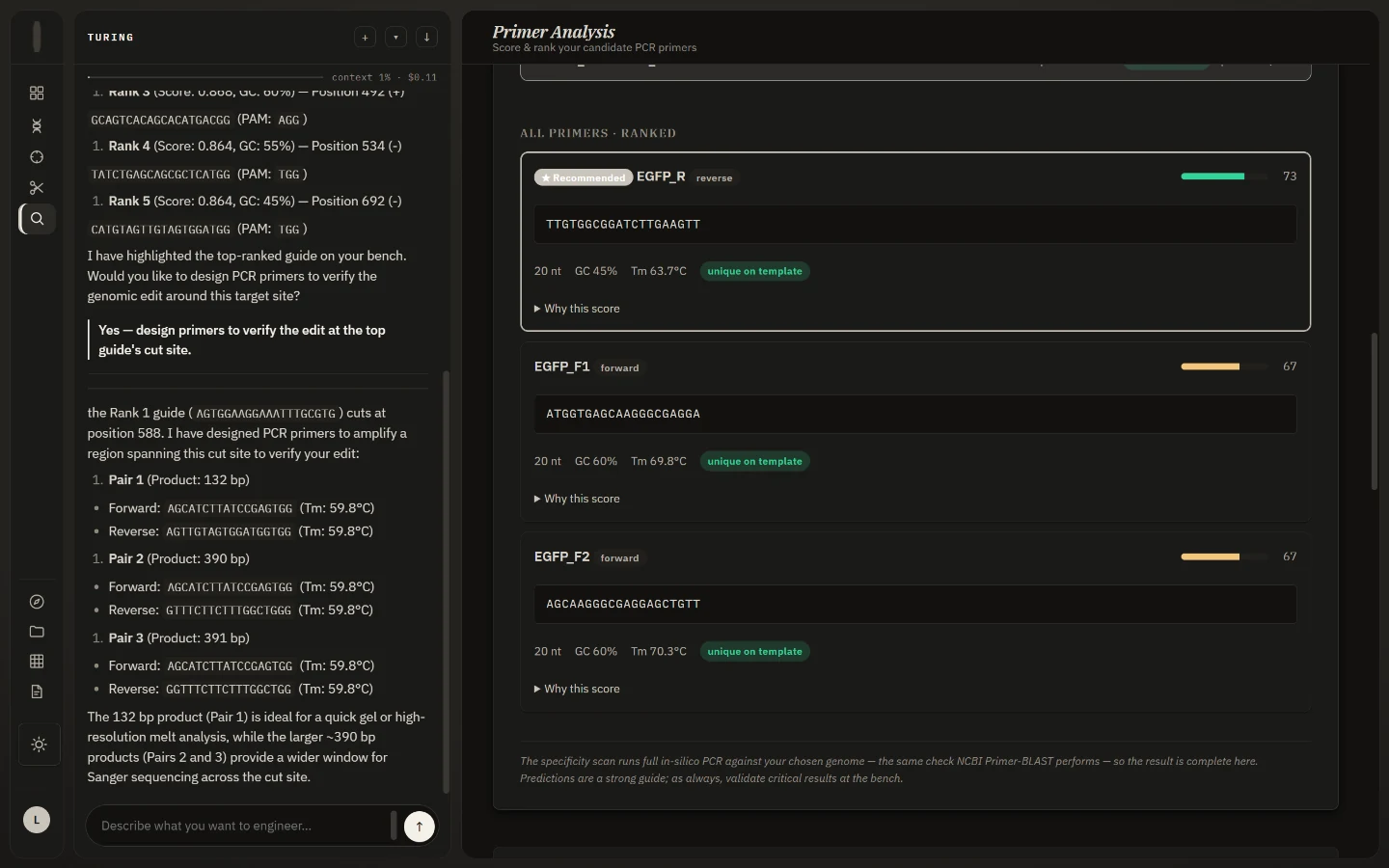
Everything folds into a score out of 100 and a plain-English recommendation of which pair to use. Running the example above returns:
PRIMER PAIRS
  ★ EGFP_F1 + EGFP_R    512 bp   ΔTm 6.1 °C   no cross-dimer   pair 60/100

ALL PRIMERS · RANKED
  ★ Recommended  EGFP_R   reverse  73   20 nt  GC 45%  Tm 63.7 °C  unique on template
                 EGFP_F1  forward  67   20 nt  GC 60%  Tm 69.8 °C  unique on template
                 EGFP_F2  forward  67   20 nt  GC 60%  Tm 70.3 °C  unique on template
The pair scores 60 while its best primer scores 73, because the pair-level ΔTm of 6.1 °C is a real penalty that neither primer carries alone. Each row has a Why this score expander with the breakdown.
Check the amplicon, not just the primers
Two primers can each score well and still fail together. The pair-level checks:
- Product size — the intended amplicon length.
- Tm match — a large gap between forward and reverse Tm means no annealing temperature suits both.
- 3′ cross-dimer — the two primers annealing to each other, which is the failure that produces primer-dimer instead of product.
Run in-silico PCR
The engine pairs every forward-oriented priming site on your template with every downstream reverse-oriented site within a sane product size — the same logic as Primer-BLAST’s specificity check — and reports the intended amplicon plus any off-target products and their sizes.
This is what catches the primer pair that works, and also produces a second band at 400 bp you were not expecting.
Products above 4,000 bp are not reported
They will not amplify under standard conditions, so listing them would be noise.
Screen against NCBI, if you choose to
The specificity scan BLASTs your candidates against NCBI nt for a chosen
organism and separates intended hits from off-target ones.
This step sends your primer sequences to NCBI
It is off by default and gated behind an explicit consent dialog. Without
consent the request returns 403 with kind: consent_required — that is
the gate working, not an error. Everything else in this tool runs locally.
Organism options are human (default), mouse, rat, zebrafish, yeast, E. coli, or all. The scan is asynchronous: it returns a job id you poll.
Screen against your own genome
If your organism is not in NCBI’s set, or you would rather nothing leave the machine, upload a genome FASTA and screen locally instead. The caps are a 12 MB file and 30 Mbp scanned — comfortable for bacterial and small eukaryotic genomes, not for mammalian ones.
Check a multiplex set
The multiplex card takes the whole set and reports cross-compatibility: which pairs cross-dimerise, which Tm values cluster badly, and which combinations would produce overlapping product sizes on a gel.
Design pairs instead of scoring them
The Design primers from a template card is the other direction: give it a
template and it proposes Tm-matched pairs, bounded by four optional fields —
Target start, Target end, Product min (bp) and Product max (bp). Use the
target range to force the amplicon to span a specific site, such as a CRISPR cut
site. This runs entirely on the server; nothing goes to NCBI.
Log what actually amplified
The Log amplification result card records whether a pair worked at the bench. It is the same idea as logging a measured variant in the evolution workflow — the run you record is what makes the next design better than a cold-start guess.
In-silico PCR is a prediction
It models 3′-anchored binding against the template you supplied. It does not know your buffer, your polymerase or your cycling conditions. Research use only.