Guides
Design a CRISPR knockout
Target to ordered oligo, in one pass — with the parts where the ranking can mislead you called out where they matter.
Updated 31 July 2026
All documentation
On this page
A knockout means cutting, letting the cell repair badly, and ending up with a frameshift that destroys the reading frame. The design job is picking the guide most likely to cut where you want and least likely to cut anywhere else.
Pick a target
Three routes in, all equivalent downstream.
By symbol. Type the gene and press Fetch. Human and mouse resolve through Ensembl; other organisms go via UniProt and EMBL.
TP53
By accession. ENST…, ENSG…, NM_…, NR_…, XM_…, XR_….
By sequence. Paste raw DNA or FASTA. Headers and whitespace are stripped and
anything outside ACGTN is dropped, so pasting straight out of a record works.
Paste DNA, not protein
The cleaner keeps only ACGTN. An amino-acid sequence survives as its
stray A, C, G, T and N letters — usually a dozen characters — and you get
“sequence is only N nt after cleaning” rather than a useful error about the
alphabet.
The cap is 1 Mbp. Human genes reach ~2.4 Mbp, so for the largest ones paste the exon or region you are editing.
Choose a nuclease
| SpCas9 | Cas12a / Cpf1 | |
|---|---|---|
| Spacer | 20 nt | 23 nt |
| PAM | NGG, 3′ |
TTTV, 5′ |
| Cut | Blunt, near the PAM | Staggered, distal to the PAM |
| Best in | GC-rich targets | AT-rich targets |
Default is SpCas9, and it is the right default. Reach for Cas12a when the region
is AT-rich enough that NGG sites are scarce, when you want staggered ends, or
when you are multiplexing — Cas12a processes its own array.
Base-edit mode is SpCas9 only. See base editing.
Screen against a genome
This is the step most worth not skipping. Leave Organism unset and the engine only checks for off-targets inside the sequence you pasted. Set it and your top-ranked guides are screened against a real reference.
| Organism | Assembly | Coverage |
|---|---|---|
| E. coli K-12 MG1655 | NC_000913.3 | Complete genome |
| S. cerevisiae | R64-1-1 | Complete genome |
| C. elegans | WBcel235 | Complete genome |
| D. melanogaster | BDGP6.46 | Complete genome |
| H. sapiens | GRCh38 | Coding sequence only |
| M. musculus | GRCm39 | Coding sequence only |
Human and mouse miss non-coding off-targets
Those two indexes are built from the Ensembl CDS bundle, because the full GRCh38 is roughly 3 GB and impractical to index inside the container. Intronic, intergenic and regulatory off-targets are outside the index — if your application turns on them, use a whole-genome tool as well.
Two mechanics worth knowing. Only the top ten ranked guides are screened,
because each genome query costs a few seconds. And the index is built on first
use — about one second per megabase, so seconds for E. coli and around three
minutes for human. Until it finishes, genome_index_status reads building and
the genome columns are blank. That is not a failure; run it again shortly.
Add a gene symbol as well to get exon context on each guide, resolved from Ensembl — useful for preferring an early constitutive exon, where a frameshift destroys the most protein.
Read the table
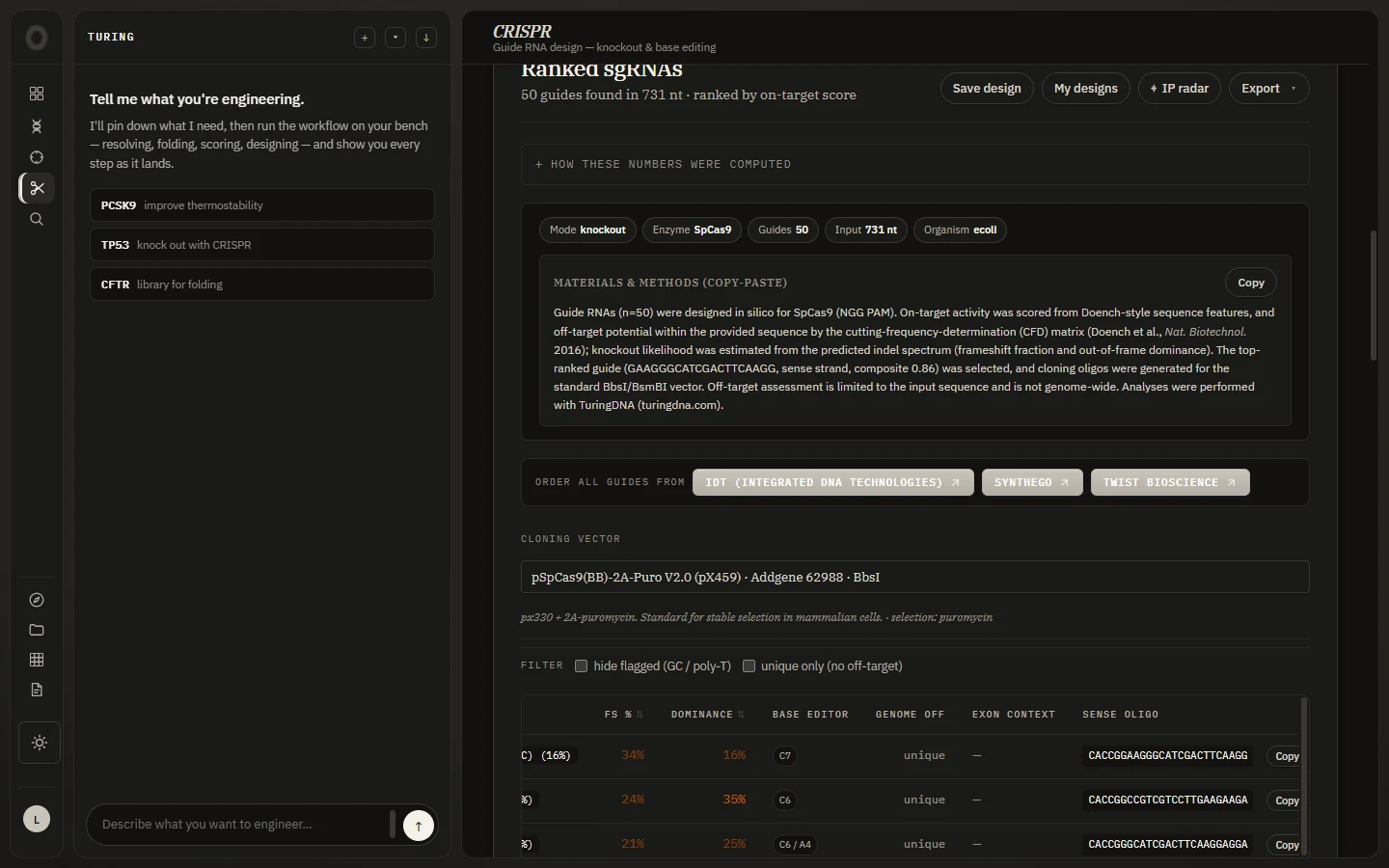
The table is twenty columns wide and scrolls sideways. Seven of them decide a choice:
| Column | Read it as |
|---|---|
| Composite | The ranking column. On-target, discounted by off-target risk |
| On-target | A ranking signal, not an efficiency estimate |
| Self-off | Worst off-target within your pasted sequence — unique if none |
| Genome off | Worst off-target in the reference, plus a hit count |
| KO score | Does this guide actually destroy the protein |
| FS % | Share of predicted repair outcomes that are out of frame |
| Dominance | Whether the frameshifting outcomes are the likely ones, not just present |
A good knockout guide is high composite, unique in both off-target columns,
high FS %, and in an early constitutive exon.
Composite and on-target are different numbers
They match for most guides, which makes the gap easy to miss. In a real
EGFP run, rank 7 scored 0.858 composite against 0.861 on-target —
the 0.01 in its self-off column pulled it down. Sorting by on-target
reorders the table and is not what the ranking used.
The remaining thirteen carry the identity of each guide (rank, strand, position, spacer, PAM, GC%), the predicted repair outcome (top indel), base-editor windows, exon context, the two cloning oligos, per-row vendor buttons, and any flags.
Two checkboxes above the table cut it down: hide flagged (GC / poly-T) drops guides with composition problems, and unique only (no off-target) keeps only guides with no hit anywhere they were screened.
Why the self-off column exists separately
Editing a tagged construct is the common case where it matters: the tag itself may contain a near-match to your spacer. A genome screen would never catch that, because the tag is not in the genome.
Copy the methods paragraph
Above the table, Materials & methods (copy-paste) generates a written methods paragraph from the run you just did — enzyme, scoring provenance with citation, the selected guide, the cloning vector, and the honest limitation. One button copies it. From the EGFP run:
Guide RNAs (n=50) were designed in silico for SpCas9 (NGG PAM). On-target
activity was scored from Doench-style sequence features, and off-target
potential within the provided sequence by the cutting-frequency-determination
(CFD) matrix (Doench et al., Nat. Biotechnol. 2016); knockout likelihood was
estimated from the predicted indel spectrum (frameshift fraction and
out-of-frame dominance). The top-ranked guide (GAAGGGCATCGACTTCAAGG, sense
strand, composite 0.86) was selected, and cloning oligos were generated for the
standard BbsI/BsmBI vector. Off-target assessment is limited to the input
sequence and is not genome-wide. Analyses were performed with TuringDNA
(turingdna.com).
It states its own limits — note it says off-target assessment is not genome-wide, which is true for a run with no organism set.
Order the oligos
Pick your cloning vector and the oligo columns re-render with the right overhangs:
| Vector | Nuclease | Selection |
|---|---|---|
px459_v2 (default) |
SpCas9 | Puromycin |
px330 |
SpCas9 | None |
px458 |
SpCas9 | GFP |
lenticrisprv2 |
SpCas9 | Lentiviral, puromycin |
plentiguide_puro |
SpCas9 | Lentiviral guide-only |
py094 (default) |
Cas12a | Cas12a geometry |
Each row’s Order cell has three buttons — IDT, SYN, TWST — that hand
that guide’s oligo pair to IDT, Synthego or Twist Bioscience. Above the table,
Order all guides from does the same for the whole set. Export gives the
table as Excel or CSV, with the research-use-only statement attached.
Check the overhangs match the vendor’s form
The oligos carry the CACC / AAAC overhangs for the vector you selected.
If you order into a different backbone, the overhangs are wrong even though
the 20-mer spacer is right.
Check prior art
IP radar searches Europe PMC, and PatentsView where a key is configured, for published work on the gene, the point mutation, or the 20-mer spacer itself. It is a literature and patent search, not legal advice — use it to find out whether a guide is already characterised, which is often more useful than the patent question.
Log what happened
After the bench, Log editing efficiency records the measured result against the design. This is the only step that produces information the scoring did not already have, and it is what makes the next round’s ranking better than this one’s. Everything upstream is prediction.
Confirm before you commit reagents
Every number on this page is a prediction, including the frameshift spectrum. Research use only — not for clinical, diagnostic, therapeutic, prophylactic, food, feed or cosmetic use.